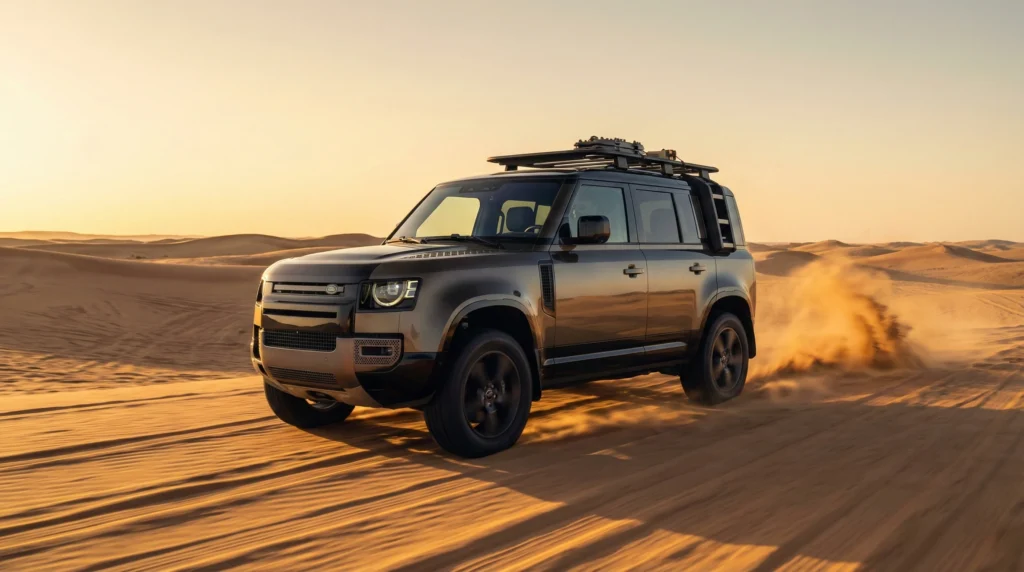
Land Rover has built its global reputation on luxury off-road dominance, but now industry chatter suggests the British automaker may be exploring a more aggressive direction — one that could position it closer to the high-flying desert capability of vehicles like the Ford Bronco Raptor.
While Land Rover has not officially confirmed plans to design SUVs specifically for airborne dune jumps, growing competition in the extreme off-road segment is pushing premium brands to rethink performance boundaries. Could we see a future Defender or special edition Land Rover engineered to handle desert terrain with Raptor-level intensity? Let’s break down what this could mean.
The Rise of Desert-Ready Performance SUVs
The off-road market has evolved beyond rock crawling and trail navigation. Vehicles such as the Bronco Raptor and Ranger Raptor have popularized high-speed desert driving, reinforced suspension systems, and long-travel shock absorbers designed for aggressive dune performance.

These vehicles are built for:
-
High-speed sand driving
-
Reinforced chassis strength
-
Advanced off-road suspension
-
Greater wheel articulation
-
Baja-style durability
Land Rover, traditionally known for controlled and refined off-road mastery, may now face pressure to adapt to this high-energy desert trend.
Land Rover’s Current Off-Road Strength
Land Rover models like the Defender and Range Rover already feature sophisticated terrain management systems. The brand’s Terrain Response technology allows drivers to select specific modes for sand, mud, snow, or rocks, automatically adjusting throttle response, suspension height, and traction control.
However, there’s a key difference between conquering dunes and launching off them. Land Rover’s philosophy focuses on:
-
Stability over airtime
-
Luxury alongside ruggedness
-
Controlled desert navigation
-
Advanced traction management
If Land Rover chooses to challenge vehicles like the Bronco Raptor in extreme sand performance, it would require suspension upgrades, structural reinforcements, and potentially a new performance sub-brand strategy.
What Would a Dune-Focused Land Rover Need?
To compete directly in the high-speed desert SUV segment, Land Rover would likely need:
-
Long-travel performance suspension
-
Heavy-duty skid plates
-
Upgraded cooling systems for desert heat
-
Reinforced chassis tuning
-
Specialized off-road tires
-
Enhanced shock absorption systems

These features are common in performance-oriented off-road vehicles designed for desert jumps and aggressive terrain driving.
Comparing Land Rover and Bronco Raptor Philosophy
Here’s how both brands currently position themselves in the off-road world:
| Feature | Land Rover Defender | Ford Bronco Raptor |
|---|---|---|
| Core Focus | Luxury + All-Terrain Control | High-Speed Desert Performance |
| Suspension | Adaptive Air Suspension | Long-Travel Heavy-Duty Suspension |
| Driving Style | Controlled Off-Road Mastery | Baja-Inspired Aggression |
| Brand Image | Premium Adventure SUV | Hardcore Performance 4×4 |
| Sand Driving | Terrain Response Sand Mode | Built for High-Speed Dune Action |
While both vehicles are capable off-road, their target audiences and engineering priorities differ significantly.
Why This Matters for the Luxury SUV Market
The global demand for performance SUVs continues to grow, especially in regions with desert landscapes such as the Middle East and parts of the United States. Buyers increasingly want vehicles that combine:
-
Off-road dominance
-
Premium interior comfort
-
Advanced driver assistance systems
-
Strong brand identity
If Land Rover were to introduce a more extreme off-road variant, it could attract enthusiasts who want luxury without sacrificing adrenaline-driven desert capability.
The Strategic Shift Toward Performance
Land Rover has already experimented with high-performance variants under the SV and SVR badges. A dune-ready performance edition would not be entirely outside the brand’s evolution path. It would represent a shift toward:
-
Performance-focused branding
-
Competitive positioning against Ford and Jeep
-
Expanding appeal among younger off-road buyers
Whether this means actual sand dune jumping or simply improved desert durability remains to be seen.
Final Thoughts
At present, Land Rover remains committed to refined off-road capability rather than dramatic airborne desert stunts. However, as competition from vehicles like the Bronco Raptor reshapes expectations in the off-road SUV segment, the British automaker may explore new performance directions.
If Land Rover decides to push into the high-speed sand dune category, it could redefine what a luxury performance SUV looks like in the modern era.
For now, the conversation reflects market evolution more than confirmed engineering changes — but the off-road landscape is shifting fast.
FAQs
1. Is Land Rover building a dune-jumping SUV?
There is no official confirmation that Land Rover is designing vehicles specifically for sand dune jumps.
2. How does Land Rover compare to the Bronco Raptor?
Land Rover focuses on luxury and controlled terrain management, while the Bronco Raptor is built for aggressive desert performance.
3. Can a Land Rover drive on sand dunes?
Yes, models like the Defender include Sand Mode in their Terrain Response system for effective dune driving.
4. Will Land Rover release a performance off-road model?
The brand already offers performance variants under SV and SVR, and future developments may expand in that direction.
5. Which SUV is better for desert driving?
It depends on driving style — for controlled luxury off-road, Land Rover excels; for high-speed desert action, the Bronco Raptor is purpose-built.